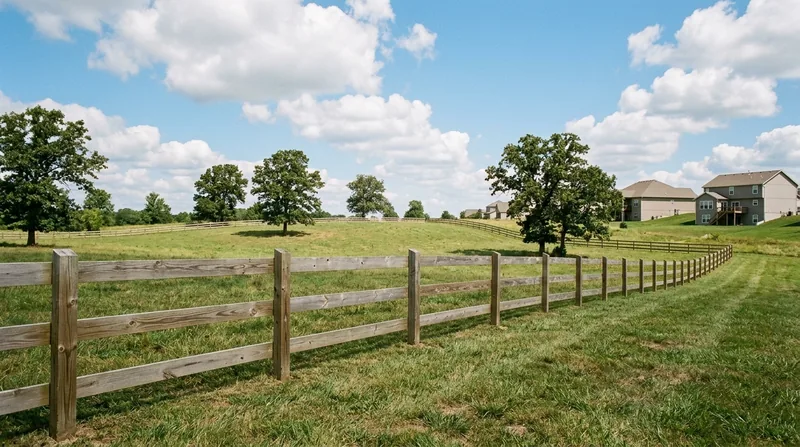




Acreage in Clay, Platte, Cass and Ray counties demands fencing built to handle livestock pressure and heavy equipment. Farm fence installation in Kansas City is not the same as residential privacy fencing, and neither is the work. We build ranch rail, no-climb horse fence, field wire and pipe fencing that stays up when animals push, when gates swing open dozens of times a day, and when the landscape shifts with frost and settling. Since 2013, Kansas City Fencing has installed and repaired working fences on farms and ranches across Greater Kansas City, and we know the difference between a fence that looks right and one that holds.
Why Farm and Ranch Fencing Matters in Kansas City
A residential fence encloses a property line. A farm or ranch fence contains livestock, controls access, and takes repeated pressure from animals and equipment. Posts must be set deeper and farther apart than residential work, rails need to be thicker, and gates need hardware that closes and latches reliably every time. The soil and site conditions across Greater Kansas City vary widely, and so does the cost to dig post holes and set them properly. Permitting requirements also differ by county and municipality, so what flies in one jurisdiction may need approval in another.
- We set posts in concrete at depths that resist frost heave and livestock pressure, not tamped earth.
- We space posts correctly for the load and the animal, whether horses, cattle or mixed stock.
- We use galvanized or powder-coated steel for pipe and metal rail work to resist rust and extend service life.
- We install self-closing, self-latching gate hardware so gates stay secure without daily attention.
- We coordinate with Missouri 811 utility locates before digging any post holes, as required by law.
Working with a local crew means you get honest guidance on what holds and what will need repair in a few years.
Key info: Ranches and horse properties in Liberty, Blue Springs and Lee's Summit often face different setback and height rules depending on whether they sit in city limits or county land. Always check with your local building department and HOA, if one applies, before we break ground.
For more on how fencing codes vary by location, see the Missouri Secretary of State business resources and contact your county assessor or planning department for setback and material rules specific to your property.
How We Build Farm and Ranch Fencing in Kansas City
Every ranch fence starts with a site walk and a clear conversation about what you need the fence to do. Are you containing horses, cattle, or mixed stock? Do you need to move equipment through regularly? What's the terrain like, and where do utilities run? We take measurements, discuss material choices, and explain what each option costs and lasts. Then we get the estimate right and stick to it.
- We verify your property line and work from your existing survey or the line you identify, never making boundary claims ourselves.
- We call 811 and wait for utility locates to mark gas, electric, water and cable before we dig.
- We dig post holes to the depth and spacing your fence type and soil conditions demand.
- We set posts in concrete and let them cure, so they stay put under load.
- We hang rails, wire or pipe, and install gates with hardware that holds tight and operates smoothly.
- We do a final walk-through with you and answer questions about maintenance and repair down the line.
Most ranch fencing jobs in Kansas City take one to three weeks from estimate to completion, depending on acreage and material choice.
Example: A 40-acre property in Grandview with 1,200 linear feet of split rail and no-climb horse fence, four gates and concrete post setting took two weeks and cost $14,400. The same acreage with pipe fencing and automatic driveway gate would run higher. We provide a detailed estimate before we start, and we don't surprise you on the bill.
If you already have fencing and need repair or replacement, see our fence repair page for details on how we diagnose and fix common problems.
Farm and Ranch Fencing Methods and Materials
| Approach | Description | Best for |
|---|---|---|
| Split Rail Fence | Wooden rails mortised into posts, 2 or 3 rails high, pressure-treated or cedar, spaced for visibility and airflow. | Horses, decorative perimeter, traditional look on acreage in Independence and surrounding areas. |
| No-Climb Horse Fence | Welded wire mesh with small grid openings, typically 4 or 5 feet tall, mounted on wooden or steel posts with rails. | Horse containment, prevents climbing and escape, safer than barbed wire in high-traffic areas. |
| Pipe Fencing | Galvanized steel pipe set in concrete, typically 2 or 2.5 inch diameter, 2 or 3 rails high, extremely durable and low maintenance. | Cattle, heavy livestock, equipment gates, maximum longevity in harsh conditions. |
| Field Wire and Barbed Wire | Woven or barbed wire strung between wooden or steel posts, posts typically 8 to 12 feet apart, wire stapled or clipped tight. | Large pastures, perimeter containment, livestock separation, lowest cost per linear foot for acreage. |
Each method has a different price point and a different lifespan. We help you match the material to what the fence has to do and what you want to spend on upkeep over the next 10 to 20 years.
Farm and Ranch Fencing Cost in Kansas City: What to Expect
Farm fencing costs vary widely because acreage, material and soil conditions are never the same twice. Split rail and no-climb horse fence typically run $11 to $18 per linear foot installed. Pipe fencing runs $16 to $24 per linear foot. Field wire and barbed wire are the lowest cost option, starting at $3 to $6 per linear foot for material, but labor to set posts and string wire properly adds to that. Gates add $400 to $2,000 each depending on width, material and hardware. An automatic driveway gate can run $3,000 to $6,000 installed.
What moves the price up or down? Soil that's rocky or wet takes longer to dig. Acreage with heavy tree cover or existing fence to remove costs more to clear. Posts set in concrete cost more than posts tamped in earth, but they hold far longer. If you need the fence in a hurry, that affects scheduling. Every job is different, which is why we ask for a site visit and give you a firm estimate before we start.
We recommend getting two or three estimates from local crews so you understand what the work costs and what you're paying for. See our full pricing page for more detail on how we price different methods and materials.
Farm and Ranch Fencing Near Me: What Kansas City Homeowners Should Know
Hiring a local crew matters when you're building a fence that has to work for years. Look for a contractor who is fully insured and can show you proof of coverage. Ask for references from other ranch or farm jobs in your area, and call them. Ask how long the crew has been in business and whether they've done work similar to yours. Check whether your HOA or county has rules about fence height, setback from the road, or material restrictions, and make sure your contractor knows those rules before giving an estimate.
We are an AFA Member Installer (American Fence Association) and have been serving Kansas City and surrounding counties since 2013. We work on ranches in Liberty, Blue Springs, Lee's Summit, Raytown, Gladstone and beyond. If you need to understand what permits apply to your property or whether your fence needs approval from a county or city building department, we help you navigate that. We also explain what to expect for maintenance and repair so you can keep the fence in good shape for the long term.
Call us at (816) 631-8814 for a free, no-obligation estimate. We respond within 24 hours and can usually schedule a site visit within a few days. Contact us online if you prefer email or want to describe the job before we call you back.
Farm & Ranch Fencing in Kansas City: Pricing Guide
| Service | Price | Details |
|---|---|---|
| Split Rail Fence | Starting at $11/ft | Two or three rails, pressure-treated or cedar, posts set in concrete, includes labor and basic hardware |
| No-Climb Horse Fence | Starting at $14/ft | Welded wire mesh with wooden or steel posts, concrete post setting, includes gate opening preparation and hardware |
| Pipe Fencing | Starting at $16/ft | Galvanized steel pipe, two or three rails, concrete post setting, extremely durable for cattle and heavy livestock |
| Field Wire or Barbed Wire | Starting at $3/ft | Material only; labor to set posts and string wire adds $2 to $4 per foot depending on soil and post spacing |
| Gates | Starting at $400 | Single swing gate with hardware; automatic driveway gates and wider ranch gates run $3,000 to $6,000 installed |
| Free Estimate | No obligation | Site visit, measurements, material options and firm pricing within 24 hours, call (816) 631-8814 |
Indicative pricing, the exact cost depends on square footage, finish, and site access. Free personalized estimate within 24h at (816) 631-8814.


